Thirteen Articles for Wherever You Land
“For now we see through a glass, darkly.” (1 Corinthians 13:12)
When the church stops holding your answers, the questions don’t go away. They get louder. How old is the world? Where did we come from? What am I supposed to do with my life now? Is anything still right or wrong?
The Articles of Faith gave you thirteen short answers when you were eight. Nobody hands you a new list on the way out, or on the way to the back pew. So people grab whatever list is nearest: a louder church, a political movement, a podcast host who’s very sure, or the bleak idea that nothing matters at all.
Here is a different list. It’s thirteen articles, like Joseph’s. The first four are about the world, and they rest on evidence. The other nine are about how to hold that world, and they rest on something harder to name. By the end you’ll have a short, workable set of footholds, and I’ll tell you why the last article is the one that holds the others up.
Not a new creed
A warning first, because a list like this can turn into the very thing it’s meant to replace.
These aren’t commandments. Nobody will interview you on them. You can drop any one of them the day you find a better one. I’ve used “We” the way Joseph did, but there’s no “we” behind it, no church and no movement. It’s an invitation, not a membership.
Most of the second half comes from David Chapman’s book Meaningness, which helped me more than anything else when meaning went gray. I’ve put his ideas in plain words. Any clumsiness is mine.
The world
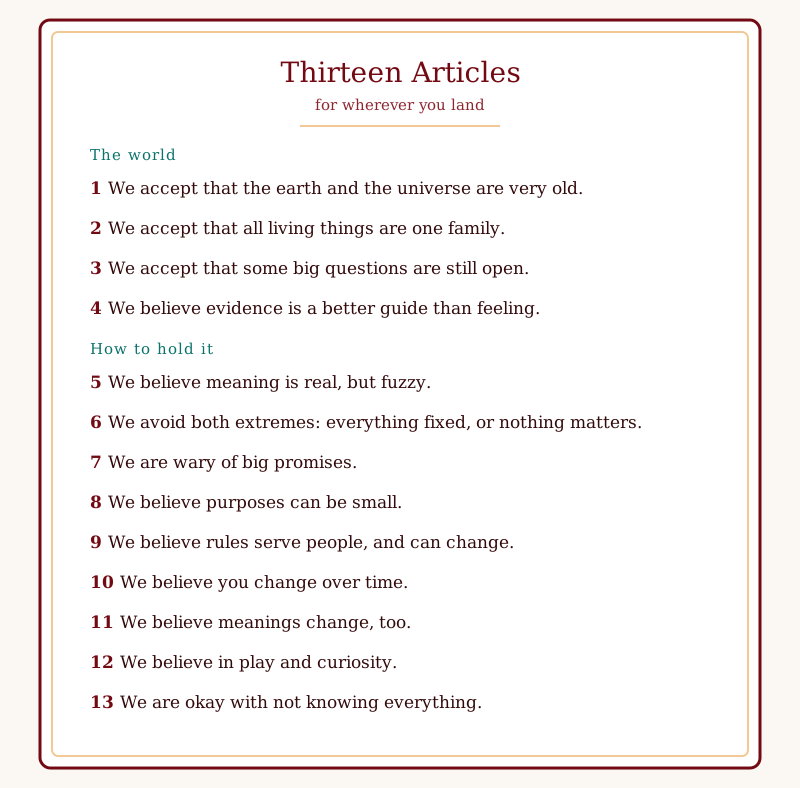
1. We accept that the earth and the universe are very old. The earth is about 4.54 billion years old, dated from meteorites and the oldest rocks with an uncertainty of under one percent (USGS). The universe is about 13.8 billion years old, measured from the faint glow left over from its earliest moments (ESA, Planck). No one has to give up wonder to accept this. The real numbers are stranger than any creation story. (More in In the Beginning.)
2. We accept that all living things are one family. Life changed slowly, over billions of years, and every living thing shares common ancestors. Becoming human was gradual, so there was no first human and no world without death before one.
3. We accept that some big questions are still open. No one yet knows exactly how life began, or what consciousness is. An open question isn’t a gap for God to fill, and it isn’t proof there’s no God. It’s a question, and people are working on it.
4. We believe evidence is a better guide than feeling. A burning in the bosom is a real experience. But people of every faith feel the same thing about opposite claims, so the feeling can’t settle which claim is true. Feelings tell you what matters to you. Evidence tells you what’s so. (More in The Things We Feel.)
How to hold it
5. We believe meaning is real, but fuzzy. Life has patterns that matter: love, work, beauty, the way strangers pull over for an ambulance. But those patterns are never perfectly clear or fixed. Chapman calls the fuzziness nebulosity. Meaning, he says, “is real, but impossible to completely pin down” (Nebulosity).
6. We avoid both extremes. It’s wrong to think everything has a set purpose, and just as wrong to think nothing matters at all. Chapman calls these eternalism and nihilism, and they’re mirror images. The better way is to notice the patterns, accept the fuzziness, and work with both. (More in Meaningness.)
7. We are wary of big promises. Some groups and some people say they have all the answers. They don’t. The promise of total certainty is the most attractive thing a system can offer, and that’s exactly why it deserves the most suspicion. As Chapman puts it, “Many specific claims of eternalist systems are plainly false” (Eternalist systems). This goes for the next thing you’re tempted to join, too.
8. We believe purposes can be small. You don’t need one huge life mission. Teaching a kid to ride a bike, fixing a neighbor’s fence, finishing a good book: little goals can make life both fun and good. My own rule is Chapman’s enjoyable usefulness: do what is enjoyable, do what is useful, and when you can, do what is both.
9. We believe rules serve people, and can change. What’s right can depend on the situation. That doesn’t mean you can do anything you want. It means you have to pay attention: to the people in front of you, to what your choice will actually do to them. The church teaches this too, in its own way. “We believe all that God has revealed, all that He does now reveal, and we believe that He will yet reveal many great and important things pertaining to the Kingdom of God” (Articles of Faith 1:9). Policies change; love for your neighbor doesn’t. (More in Changing Tides.)
10. We believe you change over time. Who you are isn’t fixed, and that’s okay. The person who bore testimony at fourteen wasn’t lying, and the person reading this isn’t a traitor to them. You’re allowed to grow out of things, and into others.
11. We believe meanings change, too. What a thing means to you shifts as you grow. A temple, a hymn, a parent’s advice can mean one thing at twenty and another at fifty. Holding too tightly to one meaning, even a new one, can hurt you and the people around you.
12. We believe in play and curiosity. Laugh, explore and try new things. Without an eternal ledger riding on every choice, you can experiment and fail without terror. The mysteries are still there, and they’re more fun to poke at than to fear. “Seek learning, even by study and also by faith” (D&C 88:118) is still good advice, whatever you think of the author.
13. We are okay with not knowing everything. You don’t have to pretend you’re sure about things you aren’t. “I don’t know” is an honest answer to a believing parent, to an angry ex-member, and to yourself at two in the morning.
“I don’t know” is an honest answer.
Why the last one holds the rest
I promised to explain why the thirteenth article matters most.
Every other article on this list is held loosely. The numbers in the first one will be refined. The ideas in the middle ones are tools, not truths, and some of them will turn out wrong. A list like this only stays honest if the person holding it can say “I’m not sure” without panic. Take away the thirteenth article and the other twelve harden into a creed.
Paul, of all people, said it first. We see through a glass, darkly. The church read that as a promise that one day we’d see clearly. Maybe. Until then, the glass is dark for everyone, believers and doubters alike, and the kindest thing we can do is admit it to each other.
For more on finding meaning after the plan of salvation, read Meaningness.