A Rock’s Birthday: What It Means to Say a Stone Is Old
When I first started taking geology seriously, I got stuck on a question that felt almost too silly to ask out loud.
A geologist picks up a rock and says it’s 1.7 billion years old. Fine. But a rock isn’t born. It doesn’t hatch from an egg or come out of a uterus. It doesn’t have a first breath. The atoms in it are older than the Earth itself. So what, exactly, is having a birthday?
It turns out that’s not a silly question at all. It’s the right one. And the answer is different for each kind of rock, which is the part nobody told me. By the end of this page you’ll know what a rock’s “age” actually measures, the main tools geologists use to measure it, and why the answer for a lava flow is a different kind of answer than the one for a sandstone cliff.
The day the clock started
Here’s the short answer, and the idea the rest of this page hangs on: a rock’s birthday is the day its clock started.
Every rock age is the time since some particular event. Not the moment the atoms came to exist, but the moment something locked them into place and started a count that couldn’t easily be reset. Change the event, and you change the birthday.
The best picture I know is an hourglass. Sand falls from the top bulb to the bottom at a steady rate. If you walk into a room and find an hourglass running, you can tell how long ago it was flipped by comparing the sand on the bottom to the sand on top. You don’t need to have been there.
But that only works if three things are true:
- The sand falls at a rate you know.
- The bottom bulb was empty when it was flipped (or you can tell how much was already there).
- Nobody has opened the glass since, adding or spilling sand.
Hold onto those three. Every dating method below is a way of finding an hourglass inside a rock and checking those three conditions.
Where the hourglasses come from
The sand in a rock’s hourglass is radioactive atoms.
Some kinds of atoms are unstable. Over time they change, one at a time, into a different element. Uranium slowly turns into lead. A form of potassium slowly turns into argon gas. The original atom is called the parent, and what it becomes is the daughter.
No one can say when any single atom will change. But in a large crowd of them, half will have changed after a fixed span of time called the half-life. Half of what’s left changes in the next half-life, and so on. Uranium-238’s half-life is about 4.5 billion years. Potassium-40’s is about 1.25 billion. Carbon-14’s is about 5,730 years.
That rate is condition one, the known speed of the falling sand. It has been measured carefully for over a century, and it doesn’t budge with heat, pressure or chemistry in any way that matters for dating rocks. (That’s what you’d expect: the change happens deep inside the atom’s nucleus, far from anything a volcano can touch.)
So count the parents and the daughters, and you know how long the clock has been running. The interesting question is when it started. That depends on what kind of rock you’re holding.
Igneous rock: born from fire
Igneous rocks are the easy case, and the closest thing a rock has to a real birth. They form when melted rock, magma underground or lava on the surface, cools and hardens. Granite and basalt are igneous.
Their birthday is the moment they crystallized.
The star witness here is a tiny, tough mineral called zircon, usually smaller than a grain of sand. When a zircon crystal grows out of a melt, its structure happily takes in uranium but almost completely refuses lead. So a fresh zircon starts with plenty of uranium and practically no lead. The bottom bulb of the hourglass is empty. That’s condition two, handed to us by chemistry.
From then on, any lead inside that crystal was made there, by uranium decaying. Measure the ratio and you have the age. This is uranium-lead dating, and it’s the gold standard for old rocks.
It gets better. Natural uranium comes in two forms that decay at different speeds into two different kinds of lead: uranium-238 into lead-206 (half-life about 4.5 billion years) and uranium-235 into lead-207 (about 700 million years). So every zircon carries two clocks running at different speeds. If the crystal has been left alone, the two clocks agree. If something has disturbed it, they disagree, and the geologist knows not to trust that grain. That’s condition three, and the rock checks it for us.
That’s how we know the oldest bits of the Earth we’ve found. Zircon grains from the Jack Hills of Western Australia crystallized about 4.4 billion years ago. The oldest intact rock, the Acasta Gneiss in northern Canada, is a little over 4 billion years old.
The volcano with a known birthday
The other workhorse for igneous rock is potassium-argon dating, and its modern refinement, argon-argon. Potassium-40 decays into argon, which is a gas. While rock is molten, gas bubbles out of it. When the lava freezes, the argon can’t escape anymore, and the clock starts at zero.
This method is perfect for volcanic ash, and here’s my favorite test of it. In AD 79, Mount Vesuvius buried Pompeii, and a Roman named Pliny the Younger wrote down what he saw. We know the date from history. In 1997, geologists dated crystals from that eruption’s pumice using argon, without peeking at the calendar. They got 1,925 years, give or take 94. The true answer was 1,918.
A rock clock built to measure millions of years landed within a few decades of a date written down by an eyewitness.
Sedimentary rock: born from the rubble of other rocks
Sedimentary rocks are where my original question really bites.
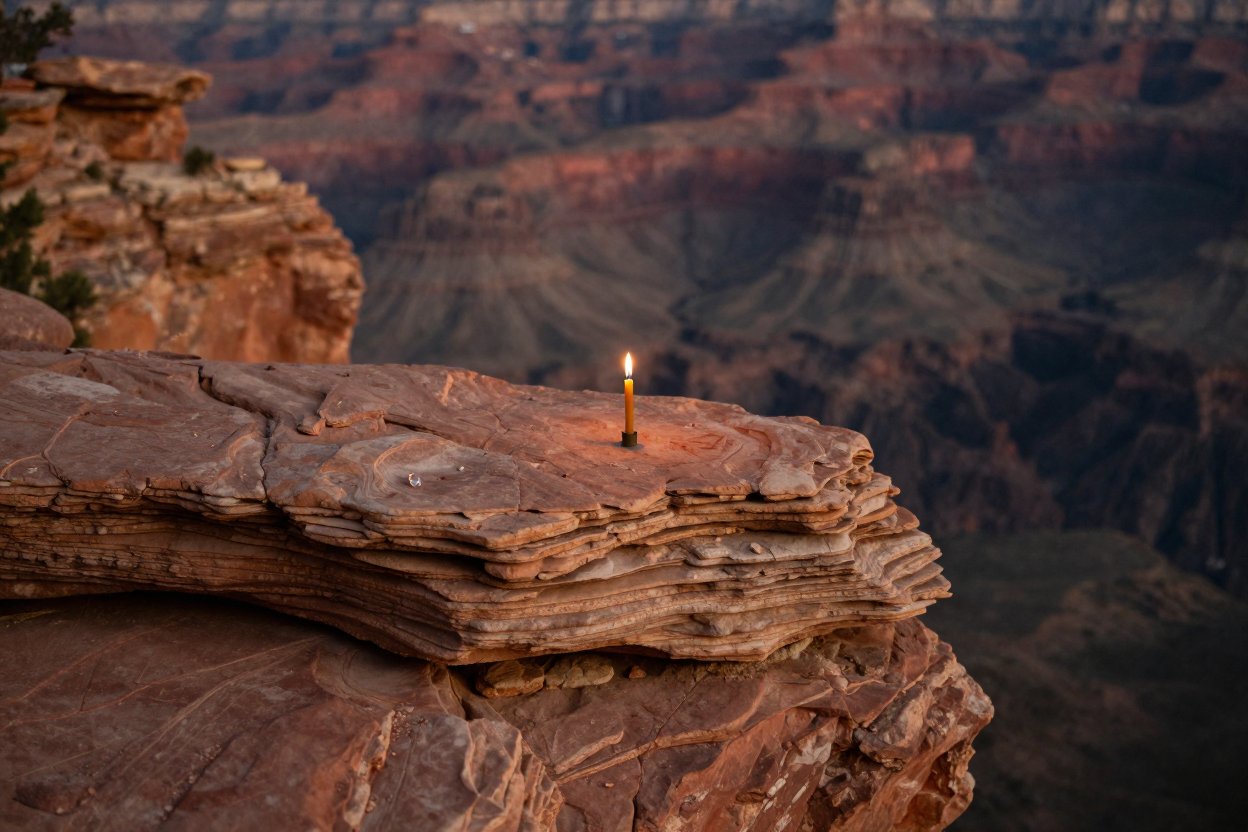
Sandstone, shale and limestone form from bits and pieces: sand grains, mud, shells. These settle in layers on a seafloor, a riverbed or a desert, get buried, and slowly harden into stone. The red cliffs of southern Utah are sedimentary. So are most of the rocks with fossils in them.
So when is a sandstone born? The sand grains in it are older than the sandstone. Each grain was once part of some other rock, maybe a granite mountain that wore away hundreds of millions of years earlier. If you date a zircon grain from a sandstone, you get the birthday of the mountain it came from, not the sandstone.
It’s like dating a brick wall by testing the clay in the bricks. You’d learn when the clay formed. You wouldn’t learn when the wall went up.
That’s why, for the most part, sedimentary rock isn’t dated directly. It’s dated by its neighbors. Geologists use a few tools together:
- Layer order. In 1669 Nicolas Steno pointed out what every kid with a sandbox knows: in a stack of undisturbed layers, the bottom one was laid down first. This doesn’t give a number. It gives an order.
- Cross-cutting. If a crack full of hardened lava slices through layers of sandstone, the lava is younger than every layer it cuts. You can’t cut a cake that hasn’t been baked.
- Volcanic ash bookends. Volcanoes sprinkle ash over the landscape, and ash is igneous, so it can be dated with the methods above. An ash bed below a layer and another above it pin that layer between two known dates. That’s how the famous fossil skeleton “Lucy” in Ethiopia was dated to about 3.2 million years: not by dating her bones, but by dating the volcanic layers around them.
- The youngest grain rule. A sandstone can’t be older than the youngest grain in it. So geologists date hundreds of zircon grains from one layer, and the youngest batch sets an upper limit: the rock formed no earlier than that.
- Fossils. Once the order of life in the rock record was worked out (and pinned down with ash-bed dates), certain fossils became time markers in their own right. Find a particular species of tiny sea creature, and you know which slice of time you’re standing in.
So a sedimentary rock’s birthday is the day its pile of loose debris was laid down, and we usually find it the way a detective sets a time of death: by what’s above it, what’s below it and what’s inside it.
Metamorphic rock: born again, sometimes more than once
Metamorphic rocks are rocks that were changed after they formed. Bury a shale deep enough and long enough, and heat and pressure cook it into slate, then schist. Squeeze a granite and it becomes gneiss. Limestone becomes marble. The rock never fully melts. It’s remade in place.
So a metamorphic rock has at least two birthdays: when the original rock formed, and when it was cooked into something new. Often it has several.
This is where the hourglass picture needs one more piece: closure temperature. A mineral’s clock only runs once the mineral is cool enough to hold onto its daughter atoms. Above that temperature, the daughters leak out as fast as they’re made, and the clock keeps resetting to zero. Below it, the glass is sealed.
Different minerals seal at different temperatures. Zircon holds its lead even when it’s very hot, roughly 900°C or more. Hornblende holds argon from about 500°C. Biotite mica, about 300°C. Tiny damage trails left in the mineral apatite by splitting uranium atoms only survive below about 100°C.
So as a deeply buried rock is pushed back up toward the surface and slowly cools, its minerals start their clocks one after another, like runners leaving the starting line at different times. Date several minerals from the same rock and you don’t get one birthday. You get a cooling history: when it was hottest, when it passed 500°C, when it passed 300°C, when it came within a few kilometers of the surface. Geologists call this thermochronology, and it’s how they work out when mountain ranges rose.
Zircon can even record two birthdays in a single grain. A crystal that survives the cooking often grows a new rim around its old core, like a tree adding rings. With an instrument that fires a beam narrower than a human hair, geologists can date the core and the rim separately. The core tells you when the original rock formed. The rim tells you when it was transformed.
And carbon dating?
You may have noticed I haven’t used the most famous dating method yet. That’s on purpose.
Carbon dating doesn’t date rocks. It measures carbon-14 in things that were once alive: wood, bone, charcoal, cloth, shells. A living thing keeps topping up its carbon-14 by eating and breathing. When it dies, the topping-up stops and the clock starts. Its birthday, in dating terms, is its death day.
With a half-life of about 5,730 years, carbon-14 is nearly all gone after about 50,000 years. That makes it wonderful for archaeology and useless for dinosaurs, which died out 66 million years ago. If anyone ever tells you dinosaur bones were carbon dated, they’ve been misinformed. The ages of dinosaurs come from the volcanic layers around them, the same way as Lucy’s.
How sure are they?
Here’s the honest version of the objection, the one I’d want answered if I were skeptical, and the one I did want answered.
“All of this rests on assumptions. How do you know the decay rate never changed? How do you know what the rock started with? How do you know nothing leaked in or out?”
That’s a fair question, and those are exactly the three hourglass conditions. Geologists worry about them constantly. It’s a large part of the job. And they have answers that don’t depend on trusting anyone:
- Different clocks agree. Uranium-238, uranium-235, potassium-argon and others decay at wildly different speeds by different processes. If the rates had drifted, they’d have drifted differently, and the clocks would disagree. Run several on the same rock and, when it’s been left alone, they agree.
- Rocks report their own tampering. Two-clock zircons and other cross-checks flag disturbed samples, and those get thrown out or studied for what disturbed them.
- The methods pass blind tests against history. Pompeii is one. There are others.
- The ages line up with the order. Dates come out older at the bottom of a canyon and younger at the top, in the same order Steno’s sandbox rule says they should, again and again, all over the world.
Is any single date certain? No. Every date comes with a plus-or-minus, and some samples give bad results. But the picture that emerges from millions of measurements, made by people who would make their careers by overturning it, is solid. And it was already surprising people in 1907, when the first uranium-lead ages came back in the billions of years.
Back to the birthday candle
So, what do we mean when we say a rock is old?
Not that it was born. Its atoms are older than the planet. What we mean is that something happened to it, it froze, it settled, it cooled, and from that moment some tiny hourglass inside it began to run. A granite’s birthday is the day it crystallized. A sandstone’s is the day its sand was laid down, found by the company it keeps. A schist may have three or four birthdays, one for each time it was remade, and each mineral in it remembers a different one.
I find that more wonderful than the simple answer I was expecting. A rock isn’t a thing with an age. It’s a record of events, and if you know how to read it, it tells you its own story.
If you want to see where this way of looking at the Earth led me, read In the Beginning: Real Rocks and a Feeling next.